The Short Answer
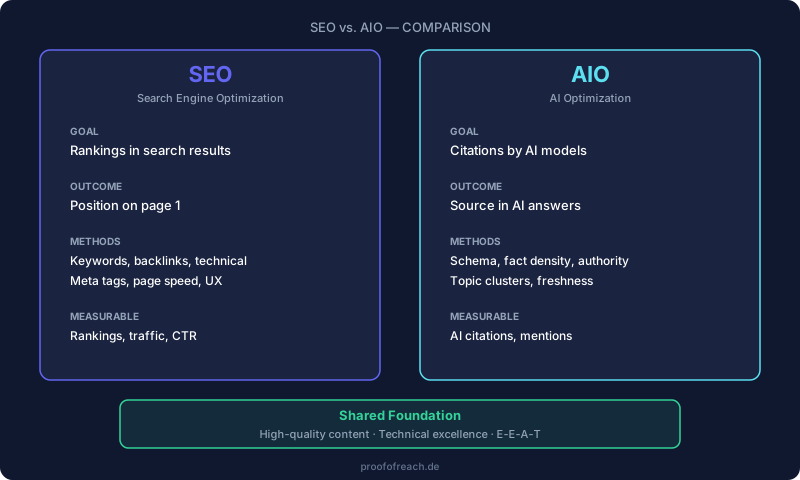
SEO (Search Engine Optimization) optimizes your website for rankings in search results from Google, Bing, and other search engines. The goal: appear as high as possible in the list of blue links.
AIO (AI Optimization) optimizes your content to be cited as a source by AI systems like ChatGPT, Perplexity, Google Gemini, and Google AI Overviews. The goal: be named as a trusted source in the AI answer.
The key insight: AIO doesn't replace SEO — it extends it. Good SEO is the prerequisite for AIO. Without rankings in organic results, you won't be cited in AI answers either. But with SEO alone, you're missing the growing channel of AI-generated responses.
SEO and AIO are not opposites. SEO is the foundation, AIO is the extension. Together they form the complete visibility strategy for 2026.
Where SEO and AIO Differ
Success Metrics
SEO measures rankings, organic clicks, impressions, and click-through rate — all available in Google Search Console. AIO measures citations in AI answers, brand mentions in AI Overviews, and how often your website appears as a source in ChatGPT or Perplexity. These metrics are harder to capture and require regular manual testing or specialized AEO tools.
Content Requirements
SEO content must be optimized for search intent and cover specific keywords. AIO content must additionally be fact-rich, clearly structured, and directly answering. Each section should directly answer a question, because AI systems extract exactly these answer blocks.
Technical Foundation
SEO requires fast load times (Core Web Vitals), mobile optimization, clean URLs, and a clear site structure. AIO extends these requirements with Schema Markup, semantically clear HTML, and structured data that help AI systems correctly interpret the content.
Authority Signals
SEO builds authority primarily through backlinks and domain authority. AIO builds authority through topical depth, entity signals, and cross-platform presence. When your brand is mentioned on LinkedIn, in specialized forums, and in the press, the likelihood increases that AI models will classify you as a trusted source.
Where SEO and AIO Overlap
The good news: most measures that are good for SEO are also good for AIO. High-quality, in-depth content works in both worlds. Fast, technically clean websites are preferred by both Google and AI systems. And topical authority — built through topic clusters with linked articles — is the most important success factor for both.
In practice, this means: you don't need two separate strategies. You need an integrated strategy that uses SEO as the foundation and adds AIO-specific optimizations.
The Integrated Strategy for 2026
Step 1: Lay the SEO foundation. Optimize Core Web Vitals, create a sitemap, set up Google Search Console, build a clean URL structure. This is the base everything else builds on.
Step 2: Add AIO optimizations. Implement Schema Markup, add FAQ sections with structured data, structure content so AI can easily extract it (direct answers, clear headings, fact-rich paragraphs).
Step 3: Build topic clusters. For both SEO and AIO, topical authority is the most important factor. Create topic clusters with a pillar article and 8–15 cluster articles.
Step 4: Update regularly. Fresh content is preferred by both Google and AI systems. Update your most important articles every 2–3 months.
Step 5: Measure and iterate. Use Search Console for SEO metrics and regularly test manually whether your website is cited in AI answers. Adjust your strategy based on the data.
Conclusion: Both or Nothing
In 2026, there's no longer a choice between SEO and AIO. Those who only do SEO lose visibility in the growing AI channel. Those who only do AIO have no rankings as a foundation. The winners are those who approach both in an integrated way — with a solid technical base, in-depth content, and the willingness to adapt to the new reality of search.
Sources
- Google Search Central: Documentation on Core Web Vitals, Schema Markup, and ranking signals. developers.google.com
- SE Ranking (Nov 2025): "How to Optimize for ChatGPT" — Data on overlap between SEO and AIO factors. seranking.com
FAQ
SEO optimizes for rankings in search results (list of links). AIO optimizes for being cited as a source by AI systems. SEO gets you to page 1, AIO gets you into the AI answer.
Yes. AIO builds on SEO — without good rankings, you won't be cited by AI models either. At the same time, SEO alone is no longer enough because more and more search queries are answered by AI responses.
SEO remains the foundation and is more important in the short term. AIO is becoming increasingly relevant long-term. The best strategy integrates both, as many SEO measures also benefit AIO simultaneously.
Last updated: March 25, 2026